OTT Advertising Strategy: A Complete Guide for Agencies
 |
Pathlabs Marketing |
 |
January 23, 2026 |
CONTENTS
Most households no longer plan their evenings around a TV schedule. They open an app, pick a show, and start streaming. That single shift has quietly rewritten the economics of video advertising, moving power from broad reach to precise relevance.
In 2025, U.S. connected TV ad spending reached roughly $33.5 billion, and growth is expected to continue through 2026 as advertisers follow audiences deeper into streaming environments.
For independent agencies, this creates both opportunity and pressure. Winning with OTT requires a disciplined audience strategy, measurement frameworks that connect exposure to outcomes, and coordination across channels where consumers move fluidly from screen to screen.
This guide breaks down the questions agencies most often ask about OTT advertising and outlines how to build a data-driven, scalable strategy that delivers real impact in a streaming-first world.
What Is OTT Advertising and Why Should Agencies Care?
OTT advertising delivers video ads over the internet across connected TVs, mobile devices, tablets, and desktop browsers. In practice, many advertisers now use OTT and CTV interchangeably, with CTV serving as an umbrella term that covers most streaming video environments.
It lets brands reach viewers where they spend more time, especially as traditional TV viewing declines and streaming consumption rises. Because people now “watch TV” across many screens and platforms, CTV is increasingly defined by the content experience rather than the physical device itself.
Most importantly for agencies, video advertising continues to outpace nearly every other digital channel. In 2025, U.S. digital video ad spending grew at a mid-teens rate, reaching more than $70 billion as brands shifted budgets toward formats that combine sight, sound, motion, and measurable outcomes.
How Do You Create a Winning OTT Strategy?
A winning OTT strategy is built on first-party data activation, programmatic precision, platform selection aligned to audience intent, and ad formats that match the viewer’s moment, all working together to deliver relevance, scale, and measurable outcomes across screens.
How Do You Use First-Party Data and Programmatic Targeting?
Agencies can use first-party data to train smarter audience segments, then activate them programmatically across screens.
In practice, that means an apparel brand might identify frequent purchasers, then use those profiles to retarget them with CTV ads followed by mobile retargeting that reinforces conversion messaging.
This approach turns OTT campaigns from shot-in-the-dark buys into data-informed delivery engines that learn and optimize over time. Indie agencies can then create an even fuller picture of consumer behavior across in-store and online shopping paths by integrating OTT with retail media strategies.
How Do Agencies Choose the Right OTT Platforms?
Agencies can choose the right OTT platforms by aligning each platform’s audience profile, content environment, and data capabilities with specific campaign goals rather than defaulting to the largest reach.
Because CTV now represents a content category more than a single device type, platform selection should prioritize where audiences are watching rather than how they are watching.
In general:
Broader services like YouTube and major FAST platforms deliver reach.
Niche programming or genre-specific channels strengthen engagement with core demographics.
What OTT Ad Formats Should Agencies Use?
Agencies should choose OTT ad formats based on the role the ad plays in the consumer journey to drive direct conversions.
One simple rule is to choose the format that matches the moment in the consumer journey you’re targeting. For example, target:
Pre-roll and mid-roll for awareness.
Interactive ads for engagement.
Shoppable units for direct conversions.
With interactive formats, viewers aren’t just watching ads — they’re participating in them. This directly connects attention to action.
Common OTT Advertising Challenges for Agencies
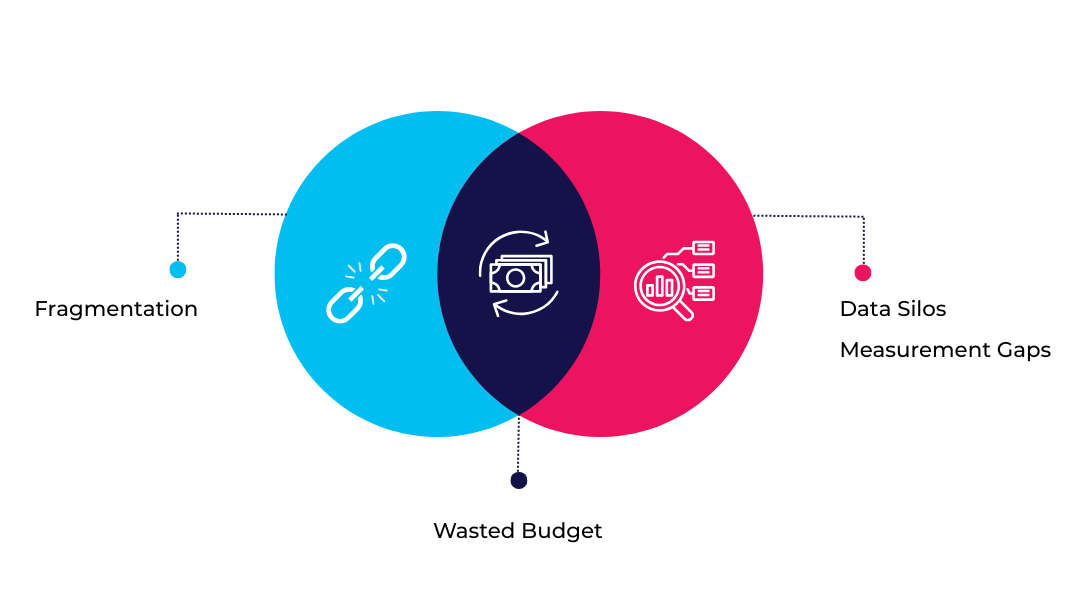
Agencies face three interconnected OTT challenges: fragmented audiences across devices and platforms, inconsistent data that doesn't connect across channels, and limited transparency in measurement. Each challenge compounds the others, making it harder to target precisely, coordinate messaging across touchpoints, and prove the true impact of OTT investment.
Why Is Targeting Still Hard Across OTT?
Without strong data linkage, agencies can misfire and serve ads to viewers who aren't likely to engage or repeatedly reach the same viewer across multiple devices, inflating frequency and wasting budget.
Audience segmentation must be grounded in first-party data (customer purchase history, website behavior, CRM records) and verified third-party signals to reduce waste and improve performance.
Why Is Cross-Channel Coordination So Difficult?
OTT doesn't operate in a bubble. A viewer might see a CTV ad in the evening, research the product on mobile the next morning, and convert on desktop that afternoon.
Many data systems still operate in silos—CTV platforms, mobile ad networks, and website analytics often don't communicate—making holistic attribution and consistent messaging difficult.
Independent agencies can address this by creating a unified measurement plan that consolidates signals across channels, connecting CTV impressions to downstream mobile and desktop behavior to see true performance patterns.
How Should Agencies Measure OTT Performance?
Agencies should measure OTT performance by pairing engagement and outcome KPIs, such as completion rates, conversions, CPA, ROAS, and incremental lift, with real-time analytics that allow campaigns to be optimized mid-flight based on what is actually driving results.
Effective OTT measurement connects how viewers interact with ads to what those interactions produce. Completion rates and view-through conversions signal attention and intent, while cost per acquisition and return on ad spend show whether campaigns are delivering efficient growth. Incremental lift adds clarity by isolating the true impact of OTT on brand and demand.
What Trends Are Shaping OTT in 2026?
OTT is evolving from a reach-driven video channel into a performance-oriented, data-informed medium. Agencies that adapt to these shifts will be better positioned to deliver relevance, efficiency, and measurable outcomes as streaming ecosystems mature.
How AI is Reshaping OTT Targeting
AI is reshaping OTT targeting by enabling more precise audience modeling, real-time optimization, and adaptive campaign execution.
AI-powered systems help agencies:
Predict audience behavior based on viewing patterns and engagement signals.
Optimize bids and placements dynamically as performance data changes.
Personalize creative delivery across audiences and contexts.
Rather than relying on static segments, AI allows OTT campaigns to learn continuously, improving efficiency and relevance with every impression.
Why Predictive Audience Modeling is Becoming More Important
Predictive modeling allows agencies to anticipate viewer intent instead of reacting after performance declines.
By analyzing historical viewing behavior, engagement trends, and cross-channel signals, agencies can:
Identify high-propensity audiences earlier in the funnel
Reduce wasted impressions by deprioritizing low-likelihood viewers
Align OTT messaging more closely with downstream conversion behavior
This forward-looking approach turns OTT from a broadcast tactic into a demand-shaping tool.
How Are Shoppable and Interactive Ads Affecting OTT?
Shoppable and interactive ads are redefining how viewers engage with OTT by turning passive viewing into active participation.
These formats enable:
Direct product exploration and purchase from the TV screen
Interactive elements such as prompts, overlays, or selectable content
Clear attribution between ad exposure and consumer action
As these formats mature, OTT becomes a bridge between brand storytelling and measurable commerce, shortening the path from attention to outcome.
Frequently Asked Questions
What’s the Difference between OTT and CTV?
OTT refers to internet-delivered video content. CTV refers to the devices, such as smart TVs and streaming sticks, that deliver that content. Today, the distinction matters far less in practice, as CTV generally encompasses OTT viewing across most streaming environments and is often used as the primary planning term.
Is OTT Growing?
Yes. OTT and CTV investments are rising year over year, and digital video is expected to continue capturing a larger share of total TV/video ad spend.
How Should Independent Agencies Approach OTT?
They should start with niche targeting and scalable formats. Focusing on streaming content rather than limiting buys to specific device types helps maximize reach, efficiency, and performance. Programmatic and predictive analytics minimize wasted impressions and maximize ROI.
The Path to Better OTT Results
Strong OTT performance does not happen by accident. It requires a disciplined execution model that brings data, media, and measurement together without friction.
Pathlabs works as an extension of agency teams through its Media Execution Partnership (MEP), a model designed to remove complexity from modern media while improving transparency, efficiency, and performance. Instead of treating OTT as a standalone channel, MEP connects it to a broader, audience-first media strategy powered by first-party data, real-time optimization, and cross-channel intelligence.
Through the MEP model, agencies can:
Reach the right audience at the right moment using data-driven segmentation and programmatic precision
Adjust campaigns dynamically based on live performance signals across platforms and devices
Tie OTT exposure directly to business outcomes with measurement frameworks built for modern video
OTT success is not just about where ads run. It is about how media is executed, optimized, and measured over time. The MEP model helps agencies turn OTT investment into sustained, measurable impact while staying prepared for what comes next in streaming and video.