Agency Guide: How Second-Screen Behavior Creates a Competitive Advantage
 |
Pathlabs Marketing |
 |
February 12, 2026 |
CONTENTS
What Is Second-Screen Behavior and Why Does It Matter Today?
Why Are Live Sports and Cultural Events Powerful Second-Screen Moments?
Who Are Second-Screen Users and Why Does It Matter for Agencies?
Real-World Second-Screen Strategies Agencies Can Apply Today
How Does Second-Screen Behavior Change CTV and Programmatic Strategy?
What Challenges Do Independent Agencies Face With Second-Screen Activation?
How Can Independent Agencies Turn Second-Screen Behavior Into Performance?
What if the most valuable ad placement during a show, movie, or major live broadcast was not on the TV at all, but on the phone in your audience’s hand?
Nearly two-thirds of U.S. viewers use a second screen while watching premium video, and more than one in three take some form of action tied to what they see on TV.
As live sports, award shows, and cultural tentpole events continue to concentrate national attention, the real battleground for performance is no longer just the biggest screen in the room. It is the moment when viewers look down, search, scroll, and decide what to do next.
What Is Second-Screen Behavior and Why Does It Matter Today?
Second-screen behavior is the practice of using a phone or other device while watching TV, and it has become the primary way audiences engage with live and premium video.
Second-screen usage is highest during live sports and marquee broadcasts, with viewers most likely to search brands, discuss the broadcast on social platforms, or visit advertiser websites during key moments. This behavior reflects active engagement and decision-making.
It is the control panel where viewers translate interest into action. For agencies, that shift changes planning. CTV advertising cannot operate alone. Mobile activation must be built into the strategy from the start.
Why Are Live Sports and Cultural Events Powerful Second-Screen Moments?
Live events are powerful second-screen moments because they combine scale, emotion, and immediacy in a way few other media environments can.
87% of sports viewers multitask during live sports events, using their mobile devices for social browsing, sports betting, or related activities while watching the game.
These events work because they bring together three forces at once:
Cultural relevance that pulls millions into the same moment.
Emotional peaks that heighten recall and curiosity.
Immediate mobile behavior that turns reaction into search, discussion, and discovery.
For advertisers, these moments behave like surges of electricity. Independent agencies that know how to capture and route that energy can convert fleeting attention into measurable business outcomes, especially when paired with programmatic media strategies designed for live environments.
What the Data Shows About Second-Screen Timing
The window for capturing second-screen behavior is narrower than most advertisers realize. Research shows that within six hours of a Super Bowl commercial airing, half of the buzz surrounding it fades, with the remaining interest plummeting over the next four days. This pattern repeats across major live events.
The implication is operational. Activation, budget shifts, and measurement must happen while interest is active, not after reporting cycles close.
Who Are Second-Screen Users and Why Does It Matter for Agencies?
Second-screen users tend to be between 18 and 54 years old, higher earners, and comfortable with technology. A strong majority of TV viewers now use a second device while watching, and 65% use that device to look up information or visit an advertiser’s site.
The pattern is consistent:
More than 80% of young and middle-aged adults use another device while watching TV, compared with roughly 65% of viewers over 55.
Usage increases with household income, signaling purchasing power and comfort with digital transactions.
For agencies, the takeaway is executional. These audiences act quickly and leave measurable signals behind. Campaigns must be designed using analytical frameworks to capture and interpret signals in real time.
From a creative and media strategy perspective, this demographic profile should influence how campaigns are built.
They expect speed, vertical design, and frictionless checkout. Campaigns that assume passive viewing limit the opportunity to drive action.
Real-World Second-Screen Strategies Agencies Can Apply Today
The defining second-screen moment came during Super Bowl XLVII in 2013. When a power outage paused the game, Oreo tweeted “You can still dunk in the dark” within minutes, generating more engagement than its in-game commercial.
The takeaway was not clever copy. It was recognizing an attention shift and responding with coordinated execution.
Today, that principle is built into media plans. Brands like Pepsi, State Farm, and DoorDash prepare second-screen activations in advance, aligning CTV buys with mobile campaigns, social listening, and programmatic follow-up before live events begin.
What Second-Screen Strategies Strengthen CTV Performance?
Second-screen strategies strengthen CTV performance by pairing television exposure with coordinated mobile activation, measurable engagement signals, and timely cross-device follow-up.
Interactive and Shoppable CTV
Streaming platforms enable QR codes and mobile prompts that turn exposure into measurable engagement while content is still playing.
Programmatic Pause Ads
Pause-based formats surface during natural viewing breaks and drive action through mobile-friendly calls to action.
Coordinated Cross-Screen Follow-Up
Live events often trigger immediate spikes in search and social activity. Brands that activate mobile search, social, and display within minutes maintain visibility while interest is high.
Mobile-First Creative Design
Effective campaigns assume multitasking behavior. CTV sets context, and mobile delivers utility or conversion through fast, frictionless experiences.
Together, these strategies demonstrate how second-screen execution transforms live attention into measurable performance, setting the stage for more integrated CTV and programmatic planning.
How Does Second-Screen Behavior Change CTV and Programmatic Strategy?
Second-screen behavior changes CTV and programmatic strategies by shifting success from isolated impressions to orchestrated, cross-device execution.
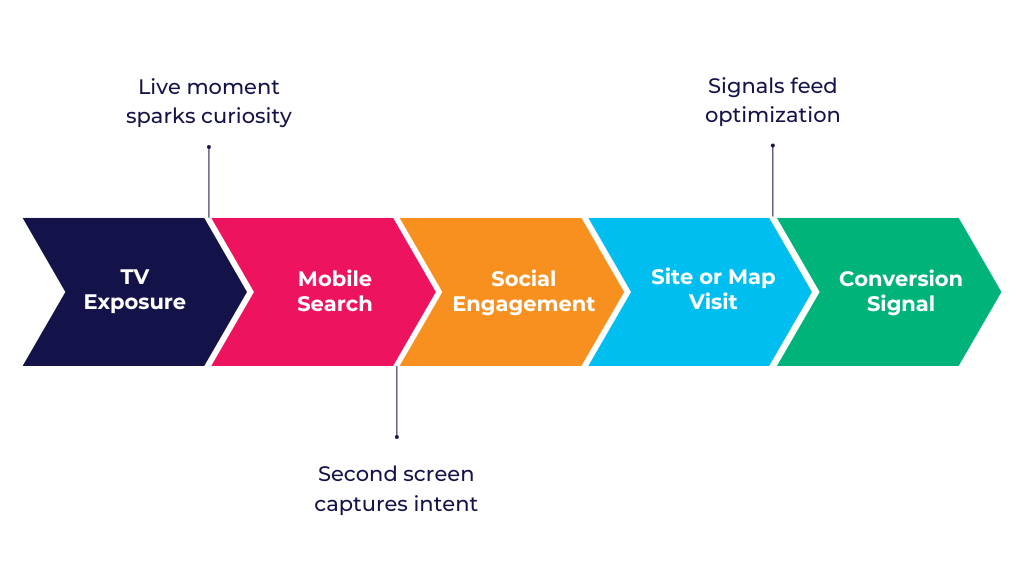
A CTV impression during a live event sparks awareness, but the second screen is where momentum compounds. Search volume rises, social engagement accelerates, and product discovery follows.
Without aligned mobile and programmatic activation, the signal fades before it turns into results.
What Challenges Do Independent Agencies Face With Second-Screen Activation?
Independent agencies face challenges with second-screen activation because fragmented reporting, delayed optimization, and limited visibility can dilute high-intent moments. For example:
A QR code that cannot be attributed.
A social spike with no clear path to conversion.
A mobile surge discovered after the moment has passed.
Many advertisers still struggle to unify data across CTV, mobile, and social channels, even as second-screen usage continues to grow. Addressing this gap requires centralized reporting and performance transparency rather than black-box solutions.
How Can Independent Agencies Turn Second-Screen Behavior Into Performance?
Independent agencies turn second-screen behavior into performance through disciplined media execution, live reporting, and continuous optimization across CTV, mobile, and programmatic channels.
Second-screen performance depends on precise execution that connects exposure, engagement, and outcomes through transparent measurement. Agencies that can track cross-screen signals, test in live environments, and optimize while attention is concentrated create repeatable performance gains.
This approach reflects the foundation of Pathlabs’ Media Execution Partnership (MEP). By prioritizing execution transparency, cross-device activation, and operational control, agencies gain the clarity needed to convert live attention into measurable business results.
As premium content continues to anchor audience attention, agencies that invest in execution discipline and integrated reporting will define the next standard for CTV performance.