Your Guide to Political Advertising & Local Election Marketing
 |
Pathlabs Marketing |
 |
December 4, 2025 |
Political advertising is experiencing a fundamental transformation. The 2026 U.S. midterm elections are expected to reach $10.84 billion in total advertising spending, up from the $8.9 billion spent in the 2022 midterms. The real story is where that money is flowing and who's spending it. Seven states are expected to see more than $50 million in state race investments, up from just four in 2024: Florida, Illinois, Michigan, North Carolina, Pennsylvania, Texas, and Virginia. With a recent surge of redistricting across the country, that number is likely to grow.
For independent agencies working at the state and regional levels, this shift presents an unprecedented opportunity. While national campaigns grab headlines, the real growth is happening in gubernatorial contests, state legislative battles, and down-ballot races that determine policy at the local level.
In this article, we’ll break down platform requirements, targeting restrictions, and the explosive rise of connected television advertising so independent agencies can navigate the new political and local election environment.
Ad Spend Is Moving to State and Local Races
The numbers tell a compelling story about where political advertising dollars are headed. State legislature ads are expected to reach $700 million in spending, up 19% from 2024. This represents a fundamental rebalancing of political advertising priorities as campaigns recognize that state-level governance has become increasingly consequential.
The driving force is congressional gridlock, which has left many Americans less likely to engage in congressional elections. In fact, only 15% of Americans approve of the way Congress is handling its job.
That has pushed advocacy groups and political organizations to focus their efforts where they can achieve tangible results, turning state races from afterthoughts into strategic imperatives.
Platform Requirements: Navigating the Compliance Maze
Political advertising operates under a unique set of rules that can trip up even experienced media buyers, as each major platform has developed its own framework for managing political content, and the differences matter.
Meta requires extensive authorization before you can even begin running political ads.
Page admins, ad account admins, and advertisers must all prove U.S. citizenship and residency, submit identification documents, and enable two-factor authentication.
Every political ad must carry a disclaimer stating who funded it, and these disclaimers must accurately represent the funding entity.
Facebook maintains an archive of political ads for seven years, creating a permanent public record.
The Trade Desk has taken a different approach focused on preventing microtargeting.
Political campaigns must maintain audience sizes of at least 1,500 unique IDs for each ad group.
The platform scans for violations every three hours, issuing warnings when audience sizes drop below the threshold.
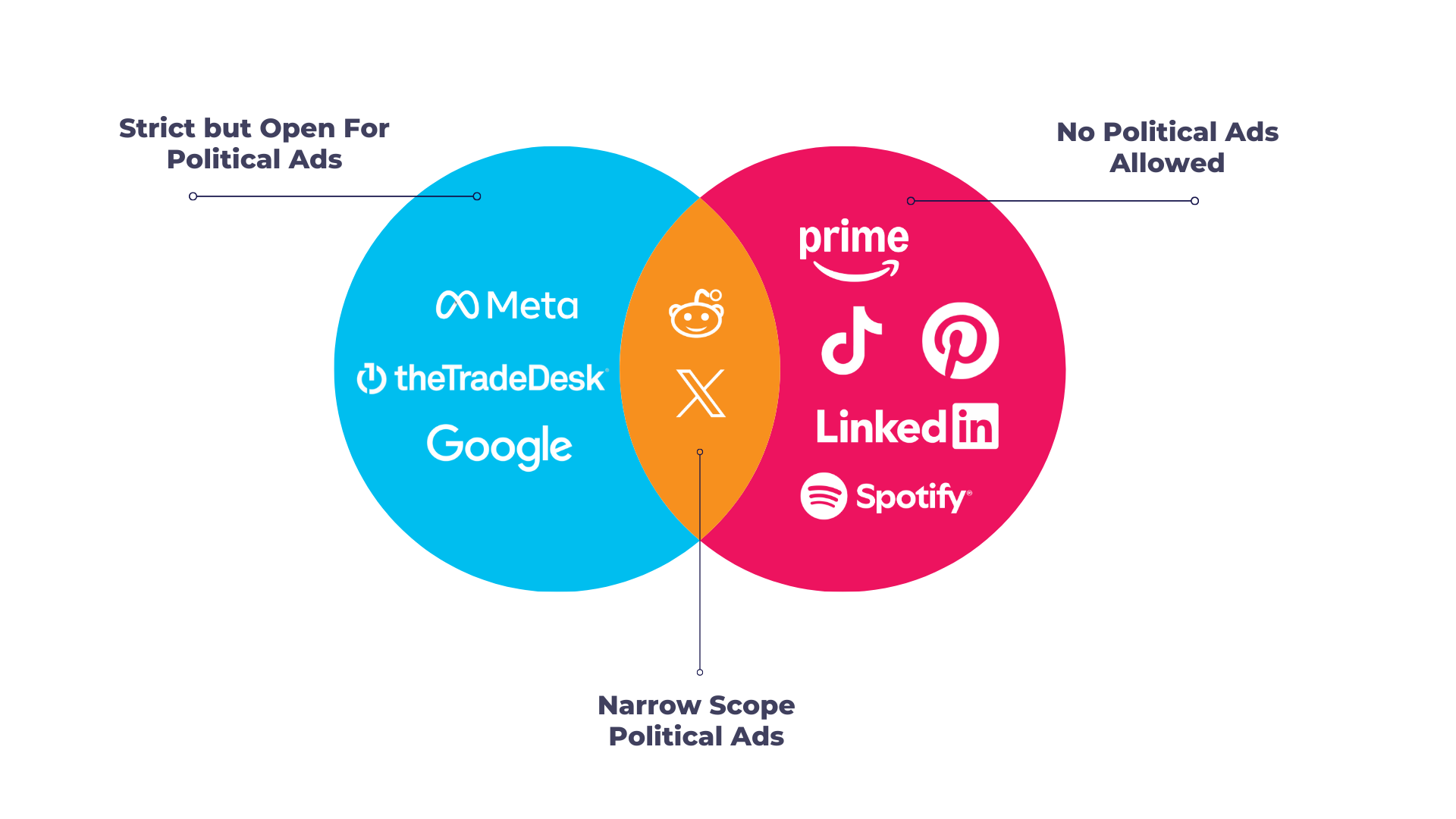
Google requires advertiser verification and mandates "Paid for by" disclosures directly in ads. The platform restricts targeting to geographic, age, gender, and contextual parameters. This limitation prevents the kind of granular behavioral targeting available for commercial advertising.
Several major platforms have chosen to avoid political advertising entirely. Platforms like Amazon Prime, TikTok, Pinterest, LinkedIn, and Spotify all prohibit political ads.
Reddit and X represent intermediate positions. Reddit restricts political ads to federal-level races and requires certification, including a live "Ask Me Anything" session with the community. X reversed its ban on political advertising in 2023 but maintains certification requirements and additional restrictions.
These platform-specific rules create real operational complexity. A campaign strategy must account for dramatically different capabilities across channels. What works on Facebook won't translate to Google.
Connected TV: The New Battleground for Political Advertising
The most dramatic shift in political advertising is happening on television screens, but not in the way most people expect. Streaming advertising is one of the fastest-growing mediums with expectations to outpace 2024 spending, with $2.48 billion in investment. CTV advertising has moved from an experimental channel to a core strategy.
Consider the trajectory. CTV will account for almost half as much spending as broadcast television, up from a quarter in 2022. That's not gradual adoption. It's a wholesale transformation of how campaigns reach voters.
Viewers have fundamentally changed their media consumption habits. Americans increasingly prefer streaming content that they can watch on their own schedules, but shifting viewership isn’t the only thing driving CTV’s growth.
CTV’s Targeting Capabilities
The appeal of CTV goes beyond simple audience reach. The technology enables targeting capabilities that traditional television cannot provide. Television is still a valuable channel for agencies running political campaigns. After all, it is the primary method of reaching seniors who vote more than any other demographic. However, CTV allows campaigns to serve different messages to different households watching the same program. It can layer multiple data sources to identify persuadable voters. It can measure ad exposure at the household level and connect it to subsequent actions.
Expanded CTV Platforms
The platform landscape for political CTV advertising has expanded dramatically. Where campaigns once considered only YouTube and Amazon Prime Video, they now have inventory available across Hulu, Netflix, Max, Disney+, Peacock, Paramount+, and more. This proliferation has made CTV advertising more affordable and accessible, particularly for state and local campaigns with smaller budgets. A similar expansion is happening in digital audio through platforms like Spotify and iHeartRadio, as well as DOOH networks in high-traffic locations.
Industry benchmarks indicate that connected TV impressions can often be purchased for significantly less than traditional broadcast television on a cost-per-thousand basis, while still delivering TV-quality reach at more efficient budgets. This means a state legislative race in a mid‑sized media market can build brand awareness through CTV without requiring a million‑dollar media budget.
Beyond CTV: Digital Audio and DOOH Channel Trends
While CTV dominates the conversation about digital political advertising, two other channels are quietly gaining momentum for 2026: digital audio and digital out-of-home (DOOH). Digital audio platforms like Spotify and podcast networks reach voters during commutes and screen-free moments, while DOOH has evolved into programmatic placements in high-traffic locations like grocery stores, gas stations, and transit hubs. Agencies planning for 2026 should consider these channels not as experimental add-ons, but as core components of a comprehensive strategy that meets voters wherever they consume media.
Takeaway: Curiosity drives action. If your content feels like every other result, people will skim it and forget it. But if you give them something that delivers personalized value, they'll stick around.
Digital Platforms: Where Precision Meets Scale
While CTV represents the fastest-growing segment, digital platforms continue to command substantial political advertising investment. Online political advertising topped $1.35 billion in 2024 on Google and Meta, with more than half coming in the final two months before the election.
Political campaigns save budget for the closing stretch, when undecided voters make final decisions and turnout operations kick into high gear. This creates intense competition for inventory and drives up costs. Ad costs on Facebook and Instagram doubled or tripled in the final weeks of the 2024 election.
The targeting capabilities of digital platforms make them particularly valuable for down-ballot races, when candidates need to reach voters at specific times. Digital advertising enables that precision in ways that traditional television cannot.
Social platforms also provide tools for engagement that go beyond passive ad viewing. Campaigns can build communities, respond to questions, and create conversations with voters. This interactive dimension matters more for state and local candidates who lack the name recognition of national figures.
Building Your State and Local Campaign Strategy
Success in state and local political advertising requires thinking differently about campaign structure and execution. You're not simply scaling down a presidential campaign. You must consider it as a distinct market with its own dynamics and requirements.
Primaries vs. General Elections
Start with a clear understanding of your competitive landscape. State and local races often feature multiple candidates competing in primaries before general election matchups. The advertising strategies that work in a crowded primary differ dramatically from two-way general election contests. Your media planning must account for these phases.
Geographic Targeting
Geographic targeting becomes both more straightforward and more complex at the state level. Simpler because your total universe is smaller and more defined. More complex because media markets rarely align with political boundaries. A state senate district might span three different media markets, requiring careful planning to avoid waste while ensuring adequate coverage.
Fortunately, with the right expertise, geotargeting can use cross-device retargeting to guide voters from awareness to action. For example, it can reach households via CTV in the weeks before Election Day, then follow up on mobile and nearby DOOH when they are at or near polling locations during the voting window.
Budget Allocation
Budget allocation patterns differ across state and local races. National campaigns can afford to maintain a presence across multiple channels simultaneously. State races often must make strategic choices about where to concentrate resources, so understanding which channels deliver the most impact for your specific electorate is crucial. Budget allocation must also match the market you are targeting. Total addressable market, reach, and frequency should all match the scale of your market to ensure tangible impact.
Dual Election Cycles
State elections in even-numbered years typically feature both spring and fall contests. This creates two distinct campaign cycles rather than a single push toward November, and voters often need weeks or even months of consistent exposure before they truly absorb a candidate’s message.
Targeted Messaging
Creative strategy must reflect the realities of state and local governance. Voters care about issues that directly affect their communities: school funding, infrastructure, local taxes, and state regulatory policies. Generic national messaging won't resonate. Your creative must demonstrate an understanding of local concerns and specific solutions.
State and local candidates often lack the professional polish of national campaigns. That can actually work to your advantage. Voters at this level expect and appreciate authenticity over production value.
Programmatic advertising plays an increasingly important role in state campaigns. The ability to layer multiple data sources, adjust targeting in real time, and optimize toward specific performance goals provides capabilities that manual buying cannot match. For agencies managing multiple state races simultaneously, programmatic infrastructure becomes essential.
Takeaway: AI is a tool for speed, not strategy. If you treat it like a shortcut, you'll end up with a lot of mediocre ads. If you treat it like a collaborator, you'll get the best of both worlds.
Measuring What Matters in Political Campaigns
Political advertising measurement aims for different goals than commercial campaigns. You're not trying to generate immediate purchases. You're attempting to influence opinions and drive behavior on a specific date when polls open.
This requires rethinking standard digital marketing metrics. Click-through rates matter less than reach and frequency within your target electorate. Engagement metrics provide signals about message resonance, but they don't directly predict electoral outcomes. CTV measurement becomes particularly important as campaigns try to understand the impact of their streaming investments.
The gold standard for political measurement remains survey research linking ad exposure to opinion change. This typically requires partnership with polling firms that can correlate media consumption patterns with voter attitudes. The expense makes this approach feasible primarily for well-funded statewide campaigns.
For down-ballot races with smaller budgets, proxy metrics become more important. Are you reaching the households you need to reach at a sufficient frequency? Is your message breaking through in crowded media environments? Are you maintaining budget efficiency relative to your targets?
Attribution in political advertising faces inherent limitations. Unlike e-commerce, political campaigns must bridge the gap between media exposure and ballot box behavior. The secret ballot prevents deterministic tracking, forcing reliance on probabilistic models and aggregate analysis.
Instead of treating legacy metrics like CPM and raw reach as “success,” agencies must focus on cost and exposure within their intended audience. For example, Cost Per Unique Reach in a target audience or incremental reach and frequency among priority voter segments.
For example, Pathlabs uses advanced political and advocacy KPIs, such as cost per unique reach in target audience and incremental exposure, to directly connect media investment to measurable shifts in reach, engagement, and voter behavior rather than vanity delivery metrics.
Looking Ahead to 2026 and Beyond
The trends reshaping political advertising will continue to accelerate through the 2026 cycle and beyond, setting a new baseline for budgets, channels, and measurement. CTV will claim an even larger share of political budgets as streaming adoption continues and platforms expand their political advertising capabilities, widening the gap between digital and traditional media spending.
State and local races will continue to attract larger advertising investments as national stalemates push more policy action to the state level. Congressional gridlock ensures that state-level governance remains the primary arena for policy change. That shift favors agencies and teams focused on regional markets.
Platform requirements are likely to tighten as concerns about misinformation, foreign interference, and ad transparency continue to drive regulatory attention. Staying current with platform policies remains a core operational discipline for political advertisers.
The Path Forward for Your Agency
For agencies and marketing teams focused on state and regional work, political advertising represents a substantial opportunity. The market is growing. The clients are well-funded during campaign cycles. The work is high-profile and consequential.
Success requires building specialized capabilities. You need team members who understand FEC compliance, platform-specific political advertising policies, and the unique measurement challenges of electoral campaigns. You need relationships with data providers who can help identify and reach target voters. You need media execution infrastructure and programmatic capabilities that enable sophisticated targeting and real-time optimization.
Pathlabs’ Media Execution Partnerships (MEP) equip agencies to expand their capacity without adding overhead by embedding media execution experts into campaign planning, execution, and optimization. MEPs don’t replace an agency’s staff. Instead, they support them with insights into the latest technologies and strategies that have been tested and proven in real campaigns.
By combining expert execution with Pathlabs' best-in-class toolset, independent agencies unlock the ability to make every dollar in their clients' budgets go further, faster, without spending resources and time expanding headcount or tech stacks.
After launch, Pathlabs execution experts continuously optimize campaigns in real time, allowing agency teams to focus on other priorities, like scaling their wins, as campaign performance improves.
The 2026 midterms are on track to be the most expensive non-presidential cycle in history. For agencies ready to serve this market with sophistication and integrity, the next several years will provide remarkable opportunities to grow.